AI Adoption the Fastest Technology Shift
MAR 31 2025 :: PHIL GERITYArtificial intelligence stands out as perhaps the most rapidly adopted technological revolution we've ever witnessed. The numbers are staggering, the implications profound, and the demographic patterns revealing. Let's dive into what the data tells us about how AI is reshaping our world—and who's leading the charge.
The Unprecedented Adoption Curve
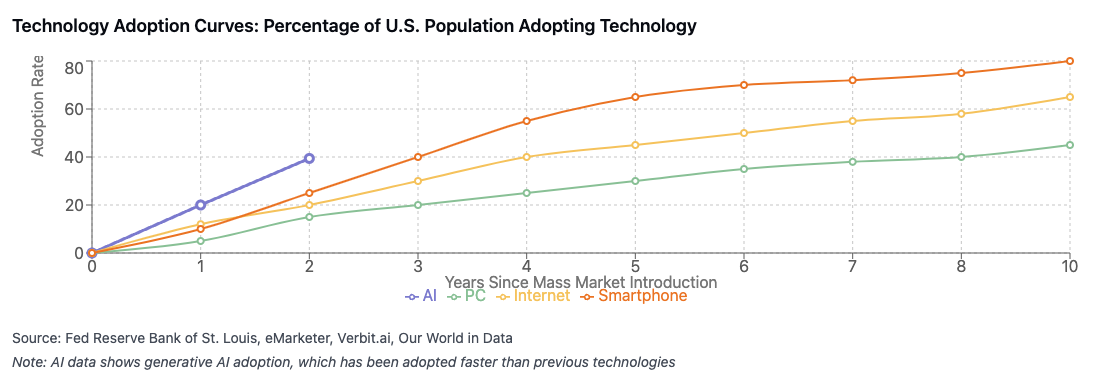
Remember how long it took for smartphones to become ubiquitous? Or the internet to transform from a novelty to a necessity? AI is outpacing them all.
Generative AI has achieved approximately 39.4% adoption within just two years of mass market introduction. By comparison, personal computers and the internet only reached about 20% adoption at similar points in their lifecycle. This represents one of the fastest technology adoption curves in history.
Projections suggest generative AI will reach 77.8 million users in the two years following ChatGPT's November 2022 release, more than doubling the adoption rates seen with both tablets and smartphones.
Why the accelerated timeline? Unlike hardware-based technologies, generative AI has minimal adoption costs. Users can access these powerful tools through devices they already own—smartphones, tablets, and computers. There's no need to purchase new equipment, which dramatically lowers the barrier to entry.
Plus, we're living in a hyperconnected world where new innovations spread at lightning speed. The digital infrastructure created by previous technologies has created the perfect environment for AI to proliferate rapidly.
Who's Leading the AI Revolution?
The demographic patterns of AI adoption reveal interesting—and sometimes concerning—trends about who's benefiting from this technological revolution.
The Gender Divide
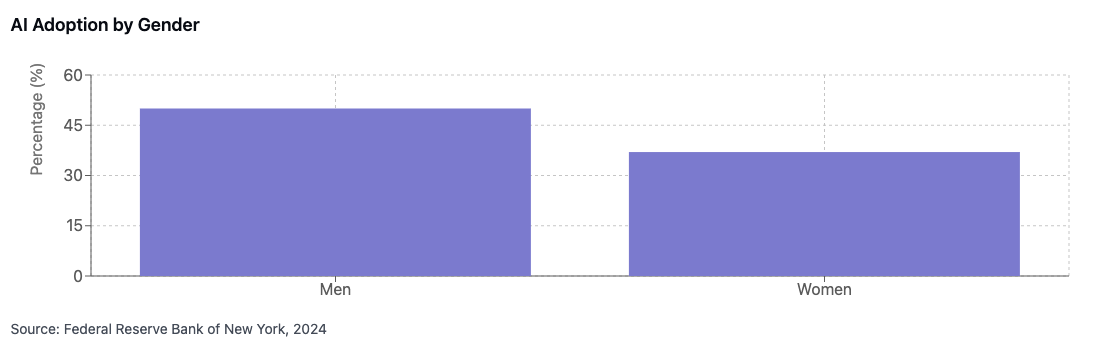
A significant gender gap exists in AI adoption. Studies consistently show men adopting AI at higher rates than women—approximately 50% of men report having used generative AI in the past year compared to just 37% of women.
This 13% gap isn't just in general usage; it persists even when comparing workers in the same occupation with similar job responsibilities. This suggests structural or societal factors may be influencing adoption rates beyond mere job requirements or opportunities.
The Youth Advantage
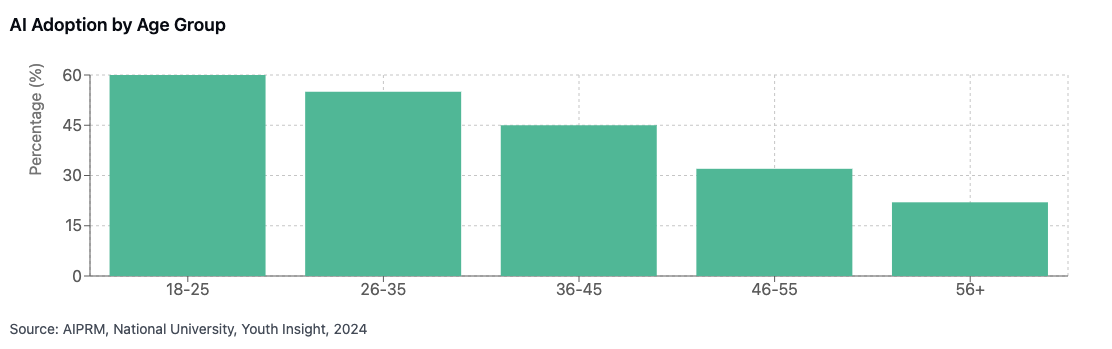
Unsurprisingly, younger generations are at the forefront of AI adoption:
- Almost 57% of those aged 18-39 feel they have moderate to high AI knowledge
- This drops to 50% for those aged 40-55
- And falls further to 39% for those over 56
Beyond just usage, younger generations also express greater interest in learning more about AI. About 86% of Gen Z and Millennials want to expand their AI knowledge, compared to 76% of Boomers.
Education as a Catalyst
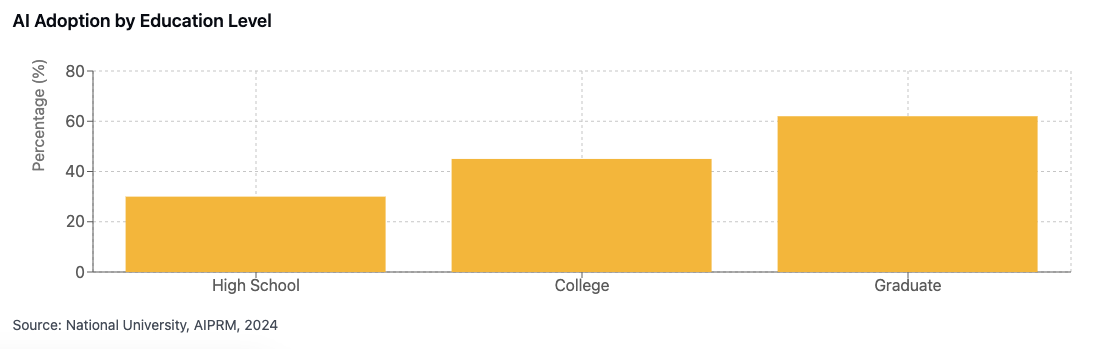
Education level strongly correlates with AI adoption and literacy. Those with a university education display about 50% greater knowledge of AI than those without higher education (62% vs. 40%) and show more enthusiasm for learning about these technologies (86% vs. 77%).
This education gap raises important questions about technological equity and whether AI might widen existing social divides rather than bridge them.
Geographic and Industry Landscapes
AI adoption isn't evenly distributed geographically or across industries.
Geographic Concentrations
In the United States, AI adoption is highly concentrated, with the San Francisco Bay Area leading as the "superstar" region. This is followed by 13 "early adopter" metro areas, 21 federal research centers, and 87 "potential adoption centers."
Globally, there are surprising patterns. Chinese and Indian firms exhibit higher AI adoption rates (60%) compared to markets like South Korea (22%), Australia (24%), the United States (25%), and the United Kingdom (26%). Low-income countries show significantly lower adoption rates, raising concerns about technological inequality on a global scale.
Industry Leaders and Laggards
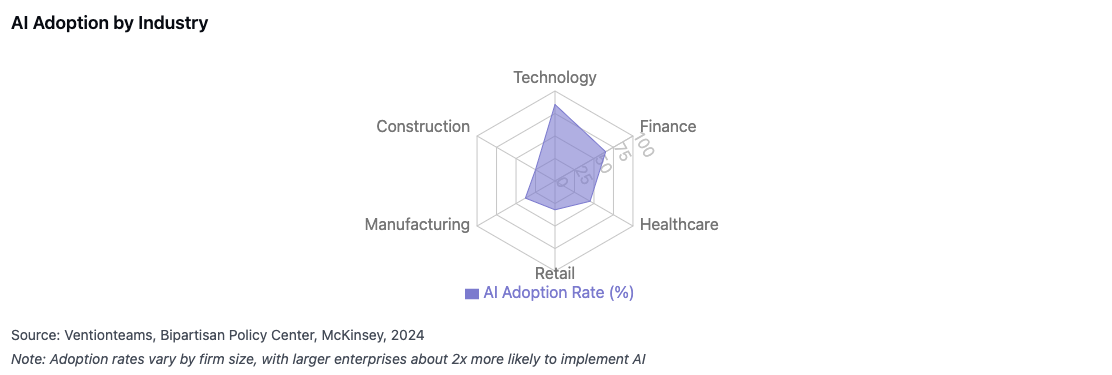
By industry, technology companies unsurprisingly lead adoption, but knowledge-based industries are catching up quickly:
- Banking, pharmaceuticals, and education are seeing significant AI impact
- Manufacturing, information services, and healthcare report adoption rates around 12%
- Construction and retail sectors lag behind at approximately 4%
The three key areas seeing the greatest concentration of AI value (approximately 75% of anticipated generative AI benefits) are marketing and sales, R&D, and customer operations.
What This Means for the Future
The rapid adoption of AI technologies has profound implications for businesses, professionals, and society as a whole.
Organizations that have already embedded AI capabilities are now leading the pack in exploring generative AI's potential. These "AI high performers" are outpacing competitors in adoption and application of these tools, suggesting a compounding advantage that may be difficult for others to overcome.
Companies expect significant business disruption from AI and are preparing for workforce changes, including potential reductions in certain areas coupled with large reskilling efforts to address shifting talent needs.
For individuals, the message is clear: AI literacy is becoming an essential skill across virtually all professional domains. Those who adapt quickly stand to benefit most, while those who delay risk falling behind in an increasingly AI-augmented workplace.
The Path Forward
As AI continues its rapid integration into our professional and personal lives, several considerations become important:
- Addressing the equity gap: Efforts should be made to ensure AI adoption doesn't exacerbate existing social, educational, and economic disparities. This includes targeted education and outreach to underrepresented groups.
- Responsible deployment: With adoption happening at unprecedented speeds, ensuring ethical use and minimizing potential harms becomes critical.
- Continuous learning: The rapid evolution of AI capabilities means continuous learning is essential for individuals and organizations alike.
- Global cooperation: Addressing the digital divide between high-income and low-income countries requires international cooperation and knowledge sharing.
The AI revolution is here, and it's moving faster than any technological shift we've seen before. Understanding who's adopting these technologies—and why—gives us valuable insights into how this revolution might unfold and what we can do to ensure it benefits as many people as possible.
Sources: Federal Reserve Bank of St. Louis (2025), McKinsey Global AI Survey (2023-2024), Verbit.ai analysis (2023), National University AI Statistics (2024), Bipartisan Policy Center (2024), Brookings Institution analysis (2023), AIPRM AI Statistics (2024), Federal Reserve Bank of New York Survey (2024), Ventionteams AI Adoption Statistics (2024)
Originally published on Product Byte (Substack)