Fast Tracking Your Journey to Product Market Fit
JAN 22 2024 :: PHIL GERITY
Recently, I had the privilege of speaking to a group of MBA candidates at MIT's Sloan School of Management, and I discovered something fascinating. Product Management, once a niche discipline, has surged in popularity among business school students. In fact, according to a recent report published by MIT, technology and product management rank as the second most popular industry and the third most sought-after function, respectively, among Sloan MBA graduates. This echoes Steve Jobs' sentiment that building things is the most rewarding thing one can do post-MBA. Although, Steve would be mildly annoyed to hear that consulting was still the top job choice for many newly minted MBAs!
When I was at Sloan completing an Executive MBA from 2021 to 2023, a new Product Management certificate was established and I've noticed many other such programs created to prepare people for tech jobs in product management. But why do these certificates exist and what exactly does it take to excel in Product Management?
The 5 Skillsets of Product Managers
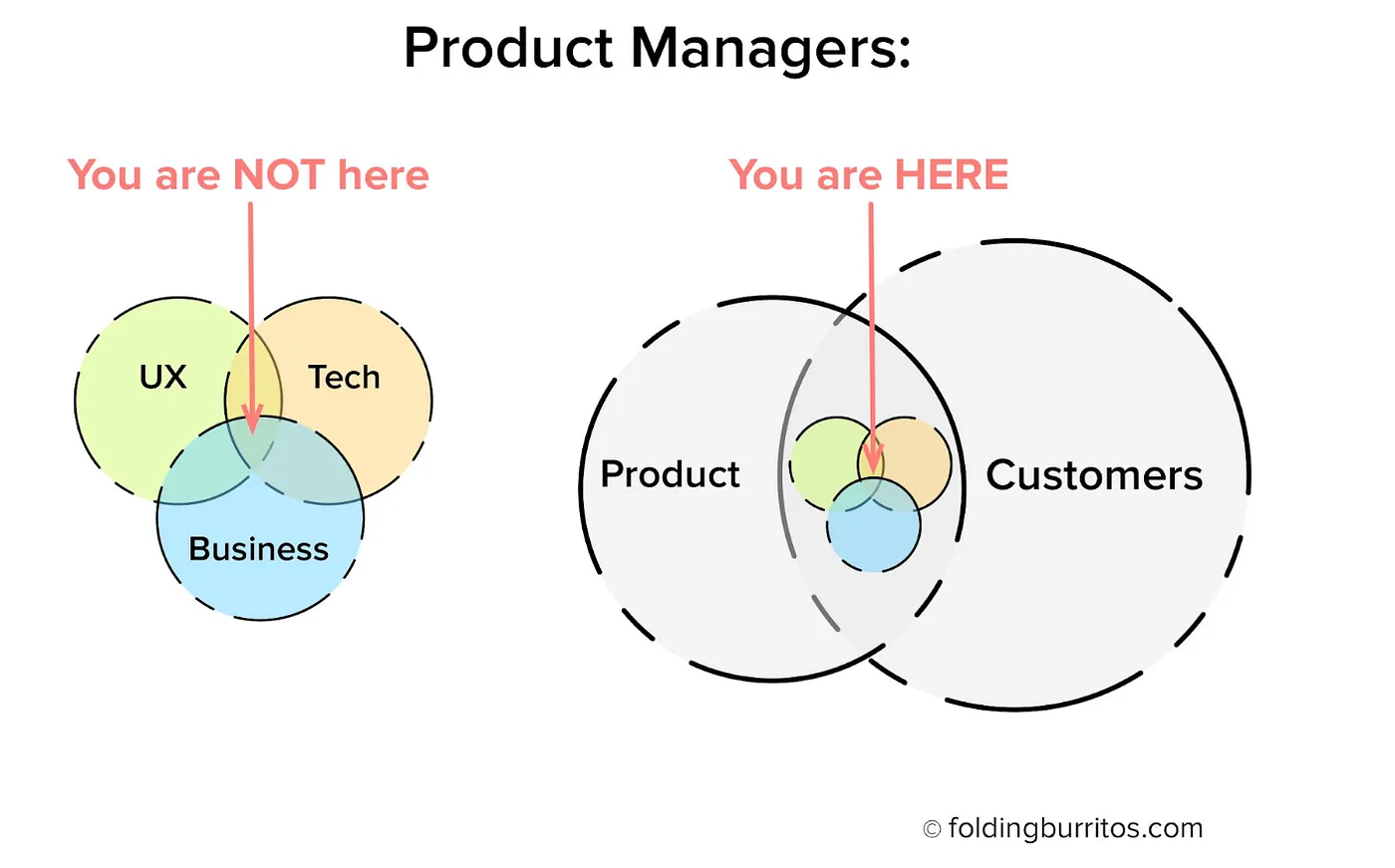
The old way of answering this question was to say that product managers were at the intersection of three overlapping disciplines: Business, Technology, and User Experience (i.e., Design). This is partially true, but there's more to product management than just these three skillsets, especially as you advance in your career.
I like Nicholas Edward's meme below that puts product managers in between the product they are building and the customers for whom they are building it.
Credit: Nicholas Edwards, Productboard, June 2022
But products and customers are not skillsets. How do we actually convert the knowledge we have about business+technology+design into products that customers want? The answer, broadly, is in honing our communication and leadership skillsets. Thus, we can deduce from Nicholas Edwards depiction of the life of a product manager that there are in fact five skillsets to master. I'll describe each below, but suffice it to say that each skillset is essentially a collection of skills and abilities.
Business
Business skills in product management involve navigating market dynamics and aligning product strategies with business goals. This includes understanding competition, industry trends, and leveraging these insights to shape product decisions. It's about striking a balance between innovation and practical business sense, ensuring the product's success in the market.
Technology
Technology skills are essential for understanding and contributing to the product's technical development. This encompasses a deep knowledge of the technology used to create products, the ability to gather and analyze data, and an understanding of systems thinking (i.e., the cause-and-effect relationships between investments). It's about ensuring that the product is technically sound, feasible, while meeting market needs. You cannot write a great product specification without knowing enough about the technology used by developers to translate between customer needs and feasible requirements.
Design
Design focuses on creating products that are not only functional but also user-centric and engaging. It involves applying creativity and design thinking to solve problems and enhance the user experience. This skill set is crucial for developing products that are intuitive, appealing, and meet user expectations.
Communication
Communication skills are key to effectively conveying ideas, aligning teams, and connecting with users. This involves clear articulation of the product vision, persuasive storytelling, and the ability to adapt messages to different audiences. Effective communication is essential for collaboration and driving the product forward.
Leadership
Leadership in product management is about guiding outcomes, creating clarity, and influencing without relying on formal authority. It involves managing relationships, holding others accountable, resolving conflicts, self-regulation, and steering projects to success. Leaders are organizational leverage points because they inspire and motivate teams to achieve collective goals.
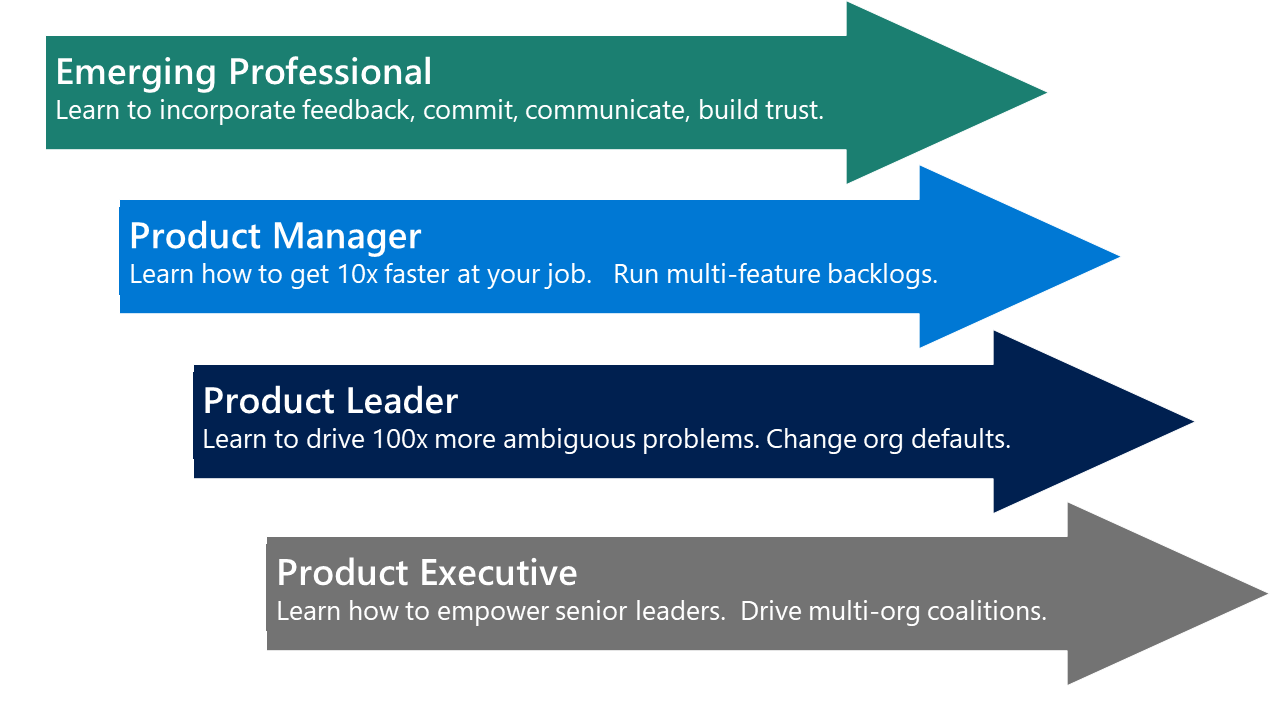
Also back in June 2022 (what a month!), Adam Harmetz laid out a nice framework for product management career stages – emerging professional, product manager, product leader, and product executive in his article, "Advancing from Product Manager to Product Leader."
Credit: Adam Harmetz, Mind the Beet, June 2022
Skillset Utilization by Career Stage
Mapping the time product managers spend exercising skillsets during each career stage, we can start to see what skillsets they lean on in each.
- Emerging Professional: Here, the focus is primarily on Technology and Design, with a foundational emphasis on Business and a growing need for Communication and Leadership skills.
- Product Manager: As they progress, Product Managers begin to balance their time more evenly among Business, Technology, and Design, while also enhancing their Leadership abilities.
- Product Leader: At this stage, there is a shift towards Business, Communication, and Leadership, reflecting the need for strategic direction and team management.
- Product Executive: Executives focus even more on Business, Communication, and Leadership, guiding strategic decisions, leading larger teams, and communicating at a higher, more strategic level. The emphasis on Technology and Design is reduced as the role becomes more strategically oriented.
We can visualize the evolution in the radar charts below.
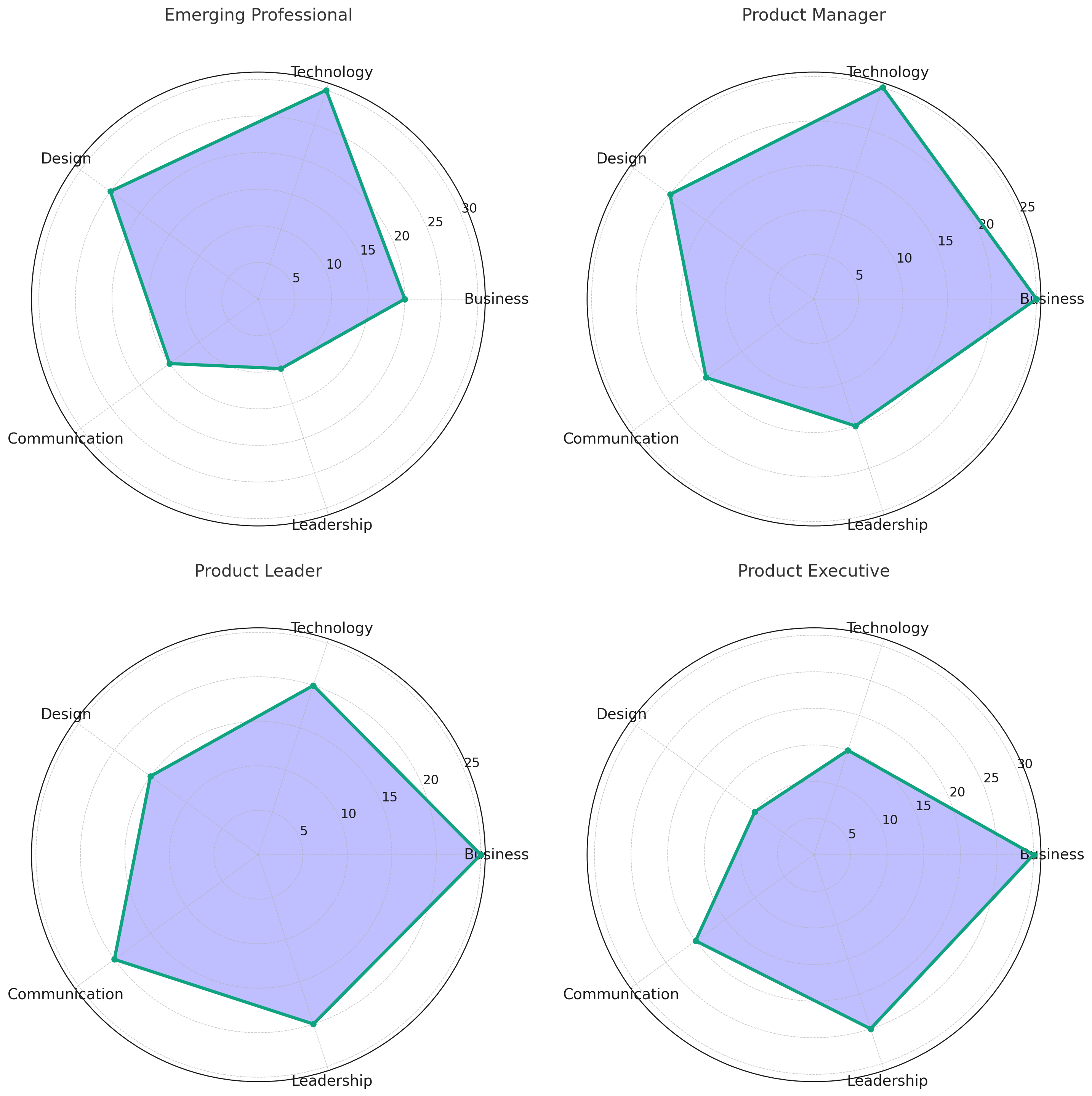
Some might argue that Product Management isn't a one-size-fits-all profession, and they'd be right. However, in many PM careers there's a clear shift towards exercising leadership and communication skills as one advances. It's the Pareto principle in action - while the foundational skills remain crucial, the more seasoned product leaders and executives find themselves increasingly leaning on their leadership and communication abilities to tell stories, influence, clarify, listen, guide, and coach.
Reflecting on my own journey from a product manager to a product executive, I've noticed this shift firsthand. Earlier in my PM journey, the focus was heavily on product creation - getting hands-on with technology, design, and gradually business strategy. However, as I have progressed into product leader and executive roles, leadership and communication took center stage. It became less about doing everything myself and more about scaling efforts through others, signaling, making a few impactful decisions, framing, and articulating visions that inspire and drive a team in the right direction.
Wrapping Up
This post scratches the surface of a much broader discussion on skill development across the span of a product manager's career. It's a journey from mastering technology and business fundamentals to excelling in communication and leadership. Recognizing these trends is just the beginning.
To support these transformations for as many product managers as possible, I'm working on an online course aimed at helping product managers transition into roles of greater leadership and influence. If you're interested in hearing more be sure to subscribe to the blog!
Originally published on Product Byte (Substack)